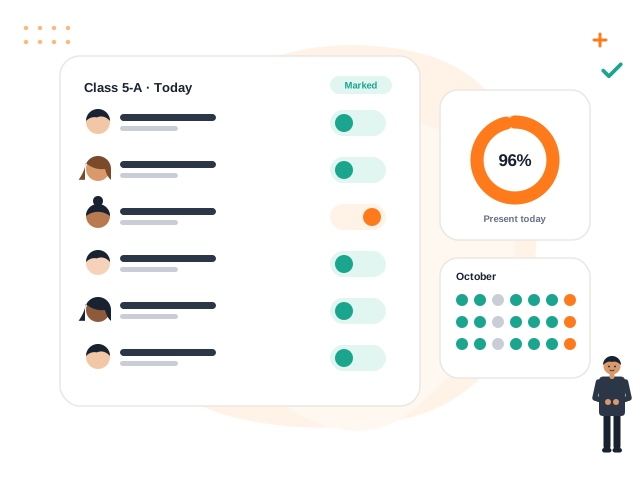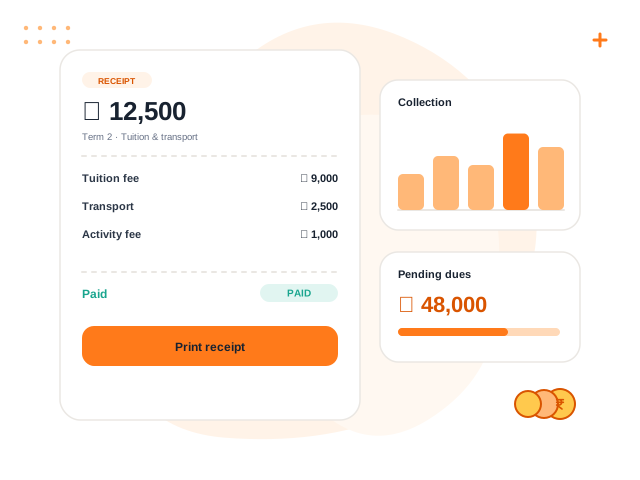
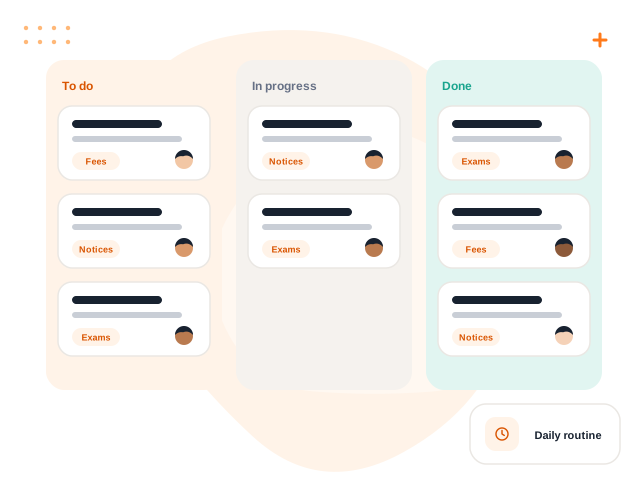
A school day is made of hundreds of small tasks: opening the gates, marking attendance, covering for absent teachers, collecting fees, answering parents, handling transport and preparing for the next event. Administrators rarely lack effort. What they lack is a system that stops small tasks from becoming daily emergencies. Organising operations is mostly about routines, clear ownership and having information in one place.
Start with what must happen every day
List the routine tasks that run every working day and note who owns each one. This simple inventory often reveals tasks that nobody owns, or that three people do in parallel.
| Time of day | Typical routine tasks |
|---|---|
| Before school | Check staff attendance, arrange substitutes, review the day's events |
| Morning | Student attendance, late arrivals, visitors, transport status |
| Mid-day | Fee counter, parent meetings, notices to be issued |
| End of day | Dispersal, transport, daily collection check, next-day preparation |
Build routines, not heroics
Organised schools run on repeatable routines instead of individual memory.
- Write a short checklist for each routine. A one-page list for opening, closing and event days helps new staff as much as experienced ones.
- Assign one owner per task. Shared responsibility often means no responsibility.
- Set fixed review times. A ten-minute briefing at the start of the day and a short review at the end prevent surprises.
- Record decisions. A line in a shared record about what was decided and by whom avoids repeated debate.
Tip: If a task has gone wrong twice, write it down as a checklist. The second failure is usually a sign the first lesson was not recorded.
Keep information in one place
Disorganisation often means the same information is scattered. The accountant knows the dues, the class teacher knows the attendance, the transport in-charge knows the routes, and the principal must ask all three. Moving towards a single shared record means questions can be answered quickly and consistently.
Aim for these principles:
- Enter each piece of information once and reuse it.
- Give people access only to what their role needs.
- Keep a history of important changes, so corrections are traceable.
Plan the academic calendar early
A calendar prepared at the start of the session saves enormous stress later. Mark holidays, exam windows, parent meetings, sports day and other events together, so clashes are visible before they happen. Share the calendar with staff and families, and update it in one place when dates change.
Timetables deserve the same attention. Build them around teacher availability and workload, and keep a clear process for substitutions, so cover arrangements are made before the first period.
Manage people fairly and clearly
Staff work better when expectations are clear.
- Define roles and responsibilities in writing.
- Keep attendance and leave records consistent and transparent.
- Provide basic training whenever a new process or tool is introduced.
- Recognise good work, and address problems early and privately.
Handle transport and safety with discipline
Transport and campus safety need particular rigour. Maintain an up-to-date list of routes, stops and the students assigned to each. Keep contact details for drivers and attendants, and make sure parents know the pick-up and drop-off arrangements. Review the list every term and whenever a student changes address or stops using the bus.
Communicate before problems grow
Many operational problems are communication problems. Announce changes early, use one official channel for notices, and acknowledge parent queries promptly. A clear notice about a changed timing prevents dozens of phone calls.
Review and improve
Once a term, sit down with the key staff and review what went well and what caused trouble. Pick two or three issues to fix rather than attempting everything at once. Small, steady improvements compound over the year.
Where software can support this
A school management system can hold student records, attendance, fees, homework, notices, events, timetables and transport in one place, with each role seeing only what it needs. Volvoq covers these areas and keeps a record of important actions, so administrators can answer questions without chasing several files. Software supports good routines but does not replace them, so settle your processes first.
Bring this into your school with Volvoq
Volvoq is a school ERP for student records, attendance, fees, exams and parent portals. Book a demo to see how it could fit your school.
Book a Demo