Fee collection is the area where small mistakes become big arguments. A receipt that cannot be found, a discount that was promised verbally, or a balance that two staff members calculate differently can strain the relationship with a family and take hours to resolve. Good fee management is mostly about clarity and records, and the right tools make both easier.
Start with a clear fee structure
Before collecting a single rupee, make sure the structure itself is unambiguous. Write down, for each class, which fee heads apply and how often they are due.
| Fee head | Example frequency | Notes to record |
|---|---|---|
| Admission fee | Once | Whether it is refundable |
| Tuition fee | Monthly or quarterly | Due date and late rules |
| Transport fee | Monthly | Linked to the chosen route or stop |
| Exam fee | Per term | Which exams it covers |
| Other charges | As needed | Reason and approval |
Share this structure with parents in writing at the start of the session. Most disputes begin because a family did not know a charge existed.
Keep concessions and discounts controlled
Concessions for siblings, staff children or financial need are common and often legitimate. The risk is that they are granted informally.
- Define each type of concession and who may approve it.
- Record the reason alongside the amount.
- Apply it in the system, not as a handwritten adjustment on a receipt.
Tip: If a concession is not recorded against the student's account, assume it will be forgotten by the next academic year. Write it down where the whole team can see it.
Issue a receipt for every payment
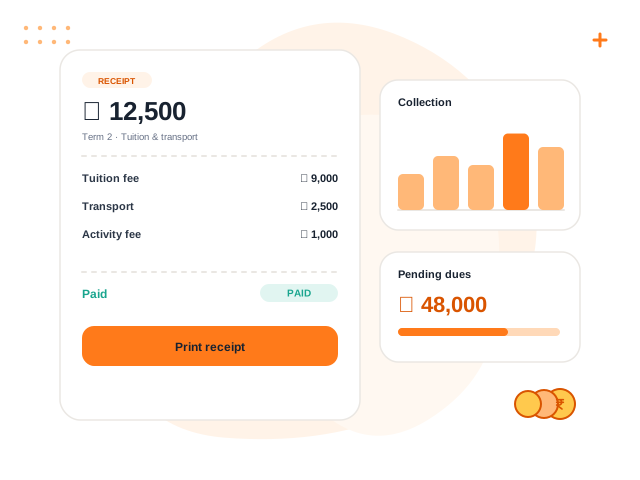
Every payment, whether by cash, cheque or bank transfer, should produce a numbered receipt. Sequential receipt numbers make it easy to spot a missing entry. Hand a copy to the parent and keep the record in the system.
For each payment, capture the date, the amount, the mode of payment, the fee heads it covers and the person who received it. If a payment must be cancelled, record a reversal with a reason rather than deleting or overwriting the original entry. This keeps the account history honest and easy to audit.
Track dues without chasing
Pending fees are easier to handle when they are visible early.
- Review dues on a fixed day each week or month. Consistency matters more than frequency.
- Group by class. Class-wise lists let the right coordinator follow up with the right families.
- Send a polite reminder before the due date, not only after it. A notice or a call from the office works for many families.
- Offer a conversation, not only a demand. If a family faces difficulty, a documented instalment arrangement is better than silence.
- Apply late rules consistently. Waiving them for some families and not others creates complaints.
Separate duties
Where possible, divide responsibilities so that no single person controls the whole cycle.
- One person defines fee structures and concessions.
- Another person collects payments and issues receipts.
- A third person, such as the principal or administrator, reviews the daily collection and bank deposits.
Small schools may not have enough staff to separate everything, but even a simple daily check by a second person reduces errors and temptation.
Reconcile regularly
Match the day's receipts against cash in hand and bank deposits at the end of each day. Do the same for bank statements at the end of each month. Small differences are much easier to trace when they are only a day old.
Keep income and expenses in the same system as fee collection so that the school can see its overall position without combining several files.
Common mistakes
- Collecting money without issuing a receipt "just this once".
- Editing old entries instead of recording a reversal.
- Keeping transport and tuition dues in different places so the total balance is never seen.
- Leaving reconciliation until the end of the year.
Volvoq supports fee structures, receipts, pending dues tracking and income and expense records for schools. Fees are recorded by the school; online payment collection is not available yet.
Bring this into your school with Volvoq
Volvoq is a school ERP for student records, attendance, fees, exams and parent portals. Book a demo to see how it could fit your school.
Book a Demo